I've done it. As a member of generation X, it was only a matter of time, really.
Before I sought non-traditional funding sources, a-la crowdfunding. (it's here!)
Funding projects via public donations, also referred to as crowdfunding, has been wildly successful for financing all sorts of imaginative (I invested in the dino-pet on kickstarter, such a neat idea!) and useful products. It has done things like help the Oscar-nominated documentary, The Square, be made; reinvent the way we charge our mobile devices (e.g. Jump cable); fund rural development projects (check out this one on indiegogo); and so much more.
A lot of people feel that crowdfunding really started taking off during the economic downturn, when the money dried up for financing new businesses and giving entrepeneurs a boost. Well, scientists are facing those same financial difficulties: the 2013 government sequester dropped funding for R&D by 5% across the board. With funding only somewhat restored this budget go-around, the outlook isn't expected to improve any time soon. Combine flat funding rates with with constantly increasing operating costs, and many scientists across all scientific fields, whether it be quantum mechanics or educational theory, are feeling the pinch.
But, after talking to people one-on-one about my research, I realize that lots of folks really do care about science, and want to support it. That's what makes crowdfunding so appealing. It empowers the individual to decide exactly what research they believe is worthy of their hard-earned paycheck. Obviously there are many scientific ventures that may not fare well in the public arena, which reinforces the need to have a diversity of government, non-profit, and other private funding sources available. But for some projects with tangible societal outcomes, crowdfunding can be a great resource, particularly when the public receives a tangible outcome. Take a look at the "American Gut" project, housed right here at CU Boulder. Anyone (American's only, sorry!) can make a donation, receive a sampling kit, and make a real contribution to the scientific process.
As for my approach to crowdfunding, I've teamed up with a great group called #SciFund. A few years ago, Jarrett Byrnes and Jai Ranganathan co-founded SciFund with the mission of strengthening connections between scientists and the public through education, awareness, and fundraising campaigns like the SciFund Challenge, of which I am currently participating.
So much emphasis these days is on the ability of scientists to translate their research to the public. Turns out that engaging the public in, for example, microbial ecology, can be a tall task. But with crowdfunding, being clear and articulate in a non-jargony way is absolutely essential. Regardless of whether I make my funding goal (which would be AWESOME!), the skills I've learned will help immensely in the future, I am confident in that. And as much as overworked and underpaid graduate students might disagree, they would all stand to benefit from going through this sometimes tortuous process. As a learning experience :)
6 paragraphs later, and I still haven't even pitched my project! I'm too meek to come right out and ask. Anyways, I'd like to understand whether microbes could be used as indicators of methane contamination from natural gas extraction activities, so that we can develop a long-term monitoring tool for keeping our groundwater safe. Check it out at https://experiment.com/methane, and if you like the idea and want to support it, please make a donation of any amount! But do it soon: the campaign ends March 7, 2014! Thanks, all.
Wednesday, February 12, 2014

Monday, November 11, 2013
Proposed hydraulic fracturing regulations in New York state
In doing research for a paper I came across a document published in 2011 by the NY Department of Environmental Conservation on newly proposed actions that might be allowed during hydraulic fracturing. The opportunity for public inquiry closed a while ago and the final report has not been completed, but considering that some of these changes might affect the public, I wanted to share. In case you are interested, the document can be found at: http://www.dec.ny.gov/docs/materials_minerals_pdf/rdsgeisch80911.pdf
The DEC is looking to allow opportunities for the following activities:
1) Issuance of a permit to drill when high-volume hydraulic fracturing is proposed shallower than 2,000 feet anywhere along the entire length of the wellbore;
2) Issuance of a permit to drill when high-volume hydraulic fracturing is proposed where the top of the target fracture zone at any point along the entire proposed length of the wellbore is less than 1,000 feet below the base of a known fresh water supply;
3) Issuance of a permit to drill when high-volume hydraulic fracturing is proposed at a well pad within 500 feet of a principal aquifer (to be re-evaluated two years after issuance of the first permit for high-volume hydraulic fracturing);
4) Issuance of a permit to drill when high-volume hydraulic fracturing is proposed on a well pad within 150 feet of a perennial or intermittent stream, storm drain, lake or pond;
5) Issuance of a permit to drill when high-volume hydraulic fracturing is proposed and the source water involves a surface water withdrawal not previously approved by the Department that is not based on the NFRM as described in Chapter 7 (of this document);
6) Any proposed water withdrawal from a pond or lake;
7) Any proposed ground water withdrawal within 500 feet of a private well;
8) Any proposed ground water withdrawal within 500 feet of a wetland that pump test data shows would have an influence on the wetland; and
9) Issuance of a permit to drill any well subject to ECL 23 whose location is determined by NYCDEP to be within 1,000 feet of its subsurface water supply infrastructure.
While it might be completely safe to allow permitting for these activities, they do appear to be loosening regulations on hydraulic fracturing in NY State, which might be of concern to local residents.
FYI.
The DEC is looking to allow opportunities for the following activities:
1) Issuance of a permit to drill when high-volume hydraulic fracturing is proposed shallower than 2,000 feet anywhere along the entire length of the wellbore;
2) Issuance of a permit to drill when high-volume hydraulic fracturing is proposed where the top of the target fracture zone at any point along the entire proposed length of the wellbore is less than 1,000 feet below the base of a known fresh water supply;
3) Issuance of a permit to drill when high-volume hydraulic fracturing is proposed at a well pad within 500 feet of a principal aquifer (to be re-evaluated two years after issuance of the first permit for high-volume hydraulic fracturing);
4) Issuance of a permit to drill when high-volume hydraulic fracturing is proposed on a well pad within 150 feet of a perennial or intermittent stream, storm drain, lake or pond;
5) Issuance of a permit to drill when high-volume hydraulic fracturing is proposed and the source water involves a surface water withdrawal not previously approved by the Department that is not based on the NFRM as described in Chapter 7 (of this document);
6) Any proposed water withdrawal from a pond or lake;
7) Any proposed ground water withdrawal within 500 feet of a private well;
8) Any proposed ground water withdrawal within 500 feet of a wetland that pump test data shows would have an influence on the wetland; and
9) Issuance of a permit to drill any well subject to ECL 23 whose location is determined by NYCDEP to be within 1,000 feet of its subsurface water supply infrastructure.
While it might be completely safe to allow permitting for these activities, they do appear to be loosening regulations on hydraulic fracturing in NY State, which might be of concern to local residents.
FYI.
What's not gray about hydraulic fracturing?
A few months ago, I began working in a microbiology lab that is working towards understanding the ecology of microbes that live in drinking water.
One of the projects I am leading aims to examine the microbiology of well water along the front range of CO (my home!). This area is particularly interesting to me and many others because natural gas extraction activities have exploded here over the past few years. The natural gas is often extracted using hydraulic fracturing techniques, which basically shoots large volumes of water, chemicals, and particles deep into drilled wells at extremely high pressures in order to create fissures in the rocks and to tease out the natural gas hidden within them. It's an amazing engineering feat by any standard and one which is creating an eruption in natural gas production nationwide.
However, hydraulic fracturing (aka fracking) can create numerous environmental and human health problems ranging from minor nuisances (noise pollution) to major impacts, such as drinking water contamination.
We've all come to accept that humanity's thirst for energy comes at a financial and environmental cost, and historically we have been willing to accept those costs, or to at least make informed decisions about our energy use. However, fracking has become highly polarizing in the media: supporters assert that the technique poses no risk to human health or the environment, while opponents insist that any fracking at all poses serious risks. Thus, an all-or-nothing environment has developed that stifles actual progress and downplays scientific facts*.
My goal with this post is to compile a list of peer-reviewed, scientific publications that test the effects of fracking activities on human health and the environment. The reason is simple: I don't believe that I know enough about the pros and cons of hydraulic fracturing to make an informed decision about how and where it should be allowed and how it should be regulated. Considering that regulation is minimal at this point in time, we've got a lot of work to do. As with many difficult topics, my opinion about fracking becomes more blurred the more I learn. I hope that, by revealing more than just soundbites I can convince you to move toward the grey areas, where compromises live.
If anyone happens to stumble across this list and has suggestions for additional articles, I'd be happy to hear from you.
*As we now know them.
One of the projects I am leading aims to examine the microbiology of well water along the front range of CO (my home!). This area is particularly interesting to me and many others because natural gas extraction activities have exploded here over the past few years. The natural gas is often extracted using hydraulic fracturing techniques, which basically shoots large volumes of water, chemicals, and particles deep into drilled wells at extremely high pressures in order to create fissures in the rocks and to tease out the natural gas hidden within them. It's an amazing engineering feat by any standard and one which is creating an eruption in natural gas production nationwide.
However, hydraulic fracturing (aka fracking) can create numerous environmental and human health problems ranging from minor nuisances (noise pollution) to major impacts, such as drinking water contamination.
We've all come to accept that humanity's thirst for energy comes at a financial and environmental cost, and historically we have been willing to accept those costs, or to at least make informed decisions about our energy use. However, fracking has become highly polarizing in the media: supporters assert that the technique poses no risk to human health or the environment, while opponents insist that any fracking at all poses serious risks. Thus, an all-or-nothing environment has developed that stifles actual progress and downplays scientific facts*.
My goal with this post is to compile a list of peer-reviewed, scientific publications that test the effects of fracking activities on human health and the environment. The reason is simple: I don't believe that I know enough about the pros and cons of hydraulic fracturing to make an informed decision about how and where it should be allowed and how it should be regulated. Considering that regulation is minimal at this point in time, we've got a lot of work to do. As with many difficult topics, my opinion about fracking becomes more blurred the more I learn. I hope that, by revealing more than just soundbites I can convince you to move toward the grey areas, where compromises live.
If anyone happens to stumble across this list and has suggestions for additional articles, I'd be happy to hear from you.
*As we now know them.
Here is the first set of articles related to Hydraulic Fracturing (added Feb 3, 2014):
Boudet H., Clarke C., Bugden D., Maibach E., Roser-Renouf C. & Leiserowitz A. (2014) “Fracking” controversy and communication: Using national survey data to understand public perceptions of hydraulic fracturing. Energy Policy 65, 57–67.
Boxall P.C., Chan W.H. & McMillan M.L. (2005) The Impact of Oil and Natural Gas Facilities on Rural Residential Property Values: A Spatial Hedonic Analysis. Elsevier B.V.
Brantley S.L., Yoxtheimer D., Arjmand S., Grieve P., Vidic R., Pollak J., et al. (2014) Water Resource Impacts during Unconventional Shale Gas Development: the Pennsylvania Experience. International Journal of Coal Geology.
Cluff, M.A., A. Hartsock, J. D. MacRae, K. Carter, & P. J. Mouser (2014) Temporal Changes in Microbial Ecology and Geochemistry in Produced Water from Hydraulically Fractured Marcellus Shale Gas Wells. Environmental Science & Technology 48: 6508–6517.
Cluff, M.A., A. Hartsock, J. D. MacRae, K. Carter, & P. J. Mouser (2014) Temporal Changes in Microbial Ecology and Geochemistry in Produced Water from Hydraulically Fractured Marcellus Shale Gas Wells. Environmental Science & Technology 48: 6508–6517.
Darrah, T.H., A. Vengosh, R.B. Jackson, N.R. Warner, & R.J. Poreda (2014) Noble gases identify the mechanisms of fugitive gas contamination in drinking water wells overlying the Marcellus and Barnett shales. Proceedings of the National Academy of Sciences USA 111:39 14076-14081.
D J. (2012) Shale gas in South Africa: Fracking the Karoo. The Economist.
D J. (2012) Shale gas in South Africa: Fracking the Karoo. The Economist.
Ecology and Environment, Inc. (2011) Economic assessment report for the supplemental generic environmental impact statement on New York State’s oil, gas, and solution mining regulatory program. Ecology and Environment, Inc., Lancaster, NY.
Eltschlager K.K., Hawkins K.K., Ehler W.C. & Baldassare F. (2001) Technical measures for the investigation and mitigation of fugitive methane hazards in areas of coal mining. Appalachian Regional Coordinating Center.
Gunningham N. (2014) A shale gas revolution for China? Climate Policy 14, 302–320.
Hamilton S.K., Golding S.D., Baublys K.A. & Esterle J.S. (2014) Stable isotopic and molecular composition of desorbed coal seam gases from the Walloon Subgroup, eastern Surat Basin, Australia. International Journal of Coal Geology 122, 21–36.
Heilweil V.M., Stolp B.J., Kimball B.A., Susong D.D., Marston T.M. & Gardner P.M. (2013) A Stream-Based Methane Monitoring Approach for Evaluating Groundwater Impacts Associated with Unconventional Gas Development. Groundwater.
Howarth R.W., Ingraffea A. & Engelder T. (2011a) Natural gas: Should fracking stop? Nature 477, 271–275.
Howarth R.W., Santoro R. & Ingraffea A. (2011b) Methane and the greenhouse-gas footprint of natural gas from shale formations. Climatic Change 106, 679–690.
Hultman N., Rebois D., Scholten M. & Ramig C. (2011) The greenhouse impact of unconventional gas for electricity generation. Environmental Research Letters 6, 044008.
Integra Realty Resources (2011) Flower Mound Well Site Impact Study. Integra Realty Resources, Dallas/Ft. Worth, TX.
IPCC (2007) The Physical Science Basis. Contribution of Working Group I to the Fourth Assessment Report of the Intergovernmental Panel on Climate Change. Cambridge, UK.
Jackson R.B., Vengosh A., Darrah T.H., Warner N.R., Down A., Poreda R.J., et al. (2013) Increased stray gas abundance in a subset of drinking water wells near Marcellus shale gas extraction. Proceedings of the National Academy of Sciences 110, 11250–11255.
Katzenstein A.S., Doezema L.A., Simpson I.J., Blake D.R. & Rowland F.S. (2003) Extensive regional atmospheric hydrocarbon pollution in the southwestern United States. Proceedings of the National Academy of Sciences 100, 11975–11979.
King J.C., Bryan J.L. & Clark M. (2012) Factual causation: The missing link in hydraulic fracture-groundwater contamination litigation. Duke Environmental Law and Policy Forum 22, 341–360.
Li H. & Carlson K.H. (2014) Distribution and origin of groundwater methane in the Wattenberg oil and gas field of Northern Colorado. Environmental science & technology.
Molofsky L.J., Connor J.A., Wylie A.S., Wagner T. & Farhat S.K. (2013) Evaluation of Methane Sources in Groundwater in Northeastern Pennsylvania. Groundwater.
Moniz E.J., Jacoby H.D., Meggs A.J.M., Armtrong R.C., Cohn D.R., Connors S.R., et al. (2011) The future of natural gas - an interdisciplinary study. Cambridge, MA: MIT Press.
Muehlenbachs L., Spiller E. & Timmins C. (2014) The Housing Market Impacts of Shale Gas Development. National Bureau of Economic Research.
Myers T. (2012) Potential contaminant pathways from hydraulically fractured shale to aquifers. Ground Water 50, 872–882.
Osborn S.G., Vengosh A., Warner N.R. & Jackson R.B. (2011) Methane contamination of drinking water accompanying gas-well drilling and hydraulic fracturing. Proceedings of the National Academy of Sciences 108, 8172–8176.
Paltsev S., Jacoby H.D., Reilly J.M., Ejaz Q.J., Morris J., O’Sullivan F., et al. (2011) The future of US natural gas production, use, and trade. Energy Policy 39, 5309–5321.
Pétron G., Frost G., Miller B.R., Hirsch A.I., Montzka S.A., Karion A., et al. (2012) Hydrocarbon emissions characterization in the Colorado Front Range: A pilot study. Journal of Geophysical Research: Atmospheres 117, 1–19.
BBC Research and Consulting B. (2001) Measuring the Impact of Coalbed Methane Wells on Property Values. BBC Research and Consulting, Denver, CO.
Soeder D.J., Sharma S., Pekney N., Hopkinson L., Dilmore R., Kutchko B., et al. (2014) An approach for assessing engineering risk from shale gas wells in the United States. International Journal of Coal Geology.
Strait R., Roe S., Bailie A., Lindquist H. & Jamison A. (2007) Colorado greenhouse gas inventory and reference case projections 1990–2020. CDPHE, Denver, CO.
Talma A.S. & Esterhuyse C. (2013) Natural Methane in the Karoo: Its Occurrence and Isotope Clues to its Origin. In: Groundwater conference, Durban. .
US EPA Hydraulic Fracturing.
US GAO (2012) Unconventional oil and gas development: Key environmental and public health requirements. U.S. Government Accountability Office.
Vengosh A., Warner N., Jackson R. & Darrah T. (2013) The Effects of Shale Gas Exploration and Hydraulic Fracturing on the Quality of Water Resources in the United States. Procedia Earth and Planetary Science 7, 863–866.
Vidic R.D., Brantley S.L., Vandenbossche J.M., Yoxtheimer D. & Abad J.D. (2013) Impact of shale gas development on regional water quality. Science 340, 826–834.
Wang Q., Chen X., Jha A.N. & Rogers H. (2014) Natural gas from shale formation–The evolution, evidences and challenges of shale gas revolution in United States. Renewable and Sustainable Energy Reviews 30, 1–28.
White J.S. & Mathes M.V. (2006) Dissolved gas concentrations in ground water in West Virginia. U.S. Geological Survey.
Willow A.J., Zak R., Vilaplana D. & Sheeley D. (2014) The contested landscape of unconventional energy development: a report from Ohio’s shale gas country. Journal of Environmental Studies and Sciences, 1–9.
Yang C. China drills Into shale gas, targeting huge reserves amid challenges. National Geographic.
Zoback M., Kitasei S. & Copithorne B. (2010) Addressing the environmental risks from shale gas development.
Friday, December 21, 2012
E. coli
o We’ve all heard the name: E.
coli.
Escherichia coli.
Most of us only care about this bacterium after an outbreak of food-borne illnessa, causing us to shun leafy greens or hamburgers for a while. But E. coli has another, brighter story
to tell that might change your perspective, and it starts with the advent of
modern microbiology. During the mid-20th century, a man by the name
of Jacques Monod and his research compadre Francois Jacob were trying to
understand gene regulation. E. coli was
already becoming a model organism in microbiology, with its nutrition and
growth characteristics and some genetic features already well described. Using the
regulation of lactose metabolism in E. coli as a model, Monod and his colleagues
uncovered a novel way by which organisms can regulate gene expression so as to maximize cellular efficiency (1) (For those of you who are reminded of introductory biology and the negative feedback loop of the lac operon, that’s what I’m talking about). As it turns out, Monod and his colleagues identified
a universal mechanism of gene regulation, which is used by many different
species and on many different genes (i.e. Tryptophan, 2). This discovery won
the posse of Frenchmen the Nobel Prize in Physiology/Medicine in 1965.
E. coli is also one of the fastest reproducing bacteria on the planet, with a generation time in the lab of less than 20 minutesc.
That equates to 24 generations in a single 8-hour work day, something that
would take about 480d years for humans to achieve!
Most of these mistakes go unnoticed because they don’t change
the physical appearance or function of the organism. But, after many
generations (and we are talking about thousands of generations), a non-lethal,
life-changing mistake can happen. The astonishing feature of this study is that
these laboratory strains of E. coli have been growing for over 40,000 generations.
The populations were grown under selective (low glucose, high citrate)
conditions to test the ability of E. coli to adapt to growth on citrate, a
compound that the original populations were unable to metabolize. Amazingly,
after about 10,000 generations some select individuals ‘evolved’ the ability to transport
citrate in the presence of oxygen, and again after another ~8,000 generations.
Escherichia coli.
 | |||||
| All good stories should start with a bunch of dudes in white lab coats. This one involve the Nobel laureates (L to R) Francois Jacob, Jacques Monod, and Andre Lwoff. Source: nobelprize.org. |
In case this esoteric example isn't enough, E. coli has also been responsible for the careers of many other influential scientists: visit
the Nobel Laureates website and search for “E. coli”, for instance, and you’ll
get 75 hitsb. Clearly this microbe has played a leading role in discovering
much of what we know about modern microbiology and genetics, and that role
continues to this day in thousands of labs all over the world (including many
labs I have worked in over the years, for topics ranging from neuron physiology
to genetic engineering).
 | |||||
| Microscopic image of E. coli after Gram staining. Based on traditional microbiological methods, E. coli is a gram-negative rod that typically occurs as single cells or doublets. Phylogenetically, it belongs to the gammaproteobacterial group. Source: G.Kaiser. |
A recently published article in the journal Nature (4) takes
advantage of this fast growth rate to trace the evolution of mutations in
laboratory strains of E. coli, in what must be the longest laboratory study of
evolution ever. You see, when it comes to evolution, what really matters is the
rate of mutations. To get mutations in a normal population, you need DNA
replication, which means you need cell division. Each time a cell replicates
its DNA, it is guaranteed to make mistakes (at an immeasurably small rate of
about 10-9 mistakes per base pair. A cool new study suggests that
this rate might be slowing in humans![3]).
 | |||
| Schematic of the development of aerobic citrate (cit) metabolism in E. coli, as depicted by Hendrickson and Rainey (doi:/10.1038/nature11487). Lineages that end in a dot went extinct due to competition. Cit+ lineages acquired the ability to metabolize citrate when oxygen was present, a clear advantage. 3 evolutionary steps were outlined (4) starting with "potentiation", or the development of mutations that provide the potential for aerobic citrate metabolism; followed by "actualization", or organization of the new genes to actually metabolize citrate, and eventually led to "refinement", or increased gene activity that increased growth on citrate. Interestingly, only 1 of the 3 citrate-metabolizing lineages made it to the "refinement" stage... |
To put this into perspective, if the cells divided at a
conservative rate of once every 30 minutes, then 10,000 generations will have
past in just over 200 days. Humans, for their entire existence (assuming that
we evolved ~1 million years ago and reproduce every 20 years) have undergone only
about 50,000 generations, highlighting one of the great values in studying
evolutionary processes in microbes. Thus, this study demonstrates that the
accumulation of mutations over time can lead to truly revolutionary changes in
a species. Amazing! From there, one could easily envision a species becoming so
different from it’s original conception that it would be considered novel.
 |
| Schematic Venn diagram illustrating the gene overlap between different strains of E. coli (not to scale). The outlined area in the center highlights the amount of genetic code shared by all strains. Pretty small, huh? |
Most people will continue to associate E. coli with illness,
and certain populations can pose a serious public health risk. But modern genomics has taught us that we cannot judge all strains based on the evil of a few. Most strains live harmoniously in our guts and do helpful things, like aiding in vitamin absorption (5). In fact, of 60 randomly sequenced E. coli isolates, only 20% of their genetic code is shared! This means that different E. coli isolates are less genetically related than we humans are to apes (~98%), and are only slightly more closely related than we are to dogs (we share about 5% of our genetic code with our "best friends", 7).
So, I hope that after reading this you now have a great deal more appreciation than apprehension when you hear the name E. coli, one of the powerhouses of modern microbiology.
So, I hope that after reading this you now have a great deal more appreciation than apprehension when you hear the name E. coli, one of the powerhouses of modern microbiology.
Notes and References
a. For the record, most E.
coli strains (serotypes) are completely harmless and reside within many
people’s guts all of the time. There are a few pathogenic strains – such as
O157:H7 – that do cause seriously disgusting illness in people. Yet another
reason to avoid eating poop.
b For comparison, S. aureus has 10 hits, Bacillus subtilis has
about 10 hits; Yeast has 179 hits! Go yeast!
c. They were strong contenders for the gold in the microbial
Olympics sprinting event, “Most Progeny”, but sadly they were overcome by phage
… (for an entertaining review, check out: Youle et al., Nature Reviews
Microbiology, 2012, 583-588).
d. Assuming an average generation time of 20 years.
1. Jacob F, Monod J (1961). Genetic regulatory mechanisms in
the synthesis of proteins. Journal of Molecular Biology 3: 318-356. PMID:
13718526.
2. Santillan M, Mackey MC (2001). Dynamic regulation of the tryptophan operonL A modeling study and comparison with experimental data. Proc. Natl. Acad. Sci. U.S.A. 80:
1364–9. doi:10.1073/pnas.98.4.1364.
3. Scally A, Durbin R (2012). Revising the human mutation
rate: implications for understanding human evolution. Nature Reviews Genetics
13 (824). doi:10.1038/nrg3353
4. Blount
ZD, Barrick JE, Davidson CJ, Lenski RE (2012). Genomic analysis of a key
innovation in an experimental Escherichia coli population. Nature 489: 513-520.
doi: 10.1038/nature11514.
5. Bentley R, Meganathan R (1982). Biosynthesis of vitamin K in bacteria. Microbiol and Molecular Biol. Reviews 46: 241-280.
6. Lukjanenko O, Wassenaar TM, Ussery DW (2010). Comparison of 61 sequenced Escherichia coli genomes. Microbial Ecology 60: 708-720. doi:10.1007/s00248-010-9717-3.
7. Lindblad-Toh K, Wade CM, Mikkelsen TS, Karlsson EK (2005) Genome sequence, comparative analysis and haplotype structure of the domestic dog. Nature 438: 803-819. doi 10.1038/nature04338.
5. Bentley R, Meganathan R (1982). Biosynthesis of vitamin K in bacteria. Microbiol and Molecular Biol. Reviews 46: 241-280.
6. Lukjanenko O, Wassenaar TM, Ussery DW (2010). Comparison of 61 sequenced Escherichia coli genomes. Microbial Ecology 60: 708-720. doi:10.1007/s00248-010-9717-3.
7. Lindblad-Toh K, Wade CM, Mikkelsen TS, Karlsson EK (2005) Genome sequence, comparative analysis and haplotype structure of the domestic dog. Nature 438: 803-819. doi 10.1038/nature04338.
Wednesday, May 30, 2012
Calling all science teachers!
Much has happened since my last post: I finished my PhD and moved to the Colorado School of Mines in glorious Golden, CO! The main thrust of the new lab is algal biofuels, with a focus on 'putting genes in, taking genes out, and seeing what happens'. In other words, I work with genetic engineers. As for me, I'm still playing with non-GMO organisms and trying to understand how growing mixtures of algae and bacteria affect algal growth. More on that in a later post.
But first, I wanted to spread the word about an online professional development course available to K-12 teachers and informal educators being offered through NEON's Citizen Science Academy (http://budburst.org/academy). If you or someone you know is looking for fun and interactive ways to engage students in the natural world, check it out!

Thursday, April 14, 2011
Oh, and one more thing
Just about an hour ago I received an email from a fellowship committee that I did not receive a dissertation completion fellowship. While it is possible that my application was sub-par, or that my letter of reference was weak, I can't help but wonder if the committee read my application and thought, "Diatoms? In my entire life I've never heard of such creatures. Why should I care about them now, especially in such dire financial times, when I could fund an applicant who studies something important, like cancer?".
Well, I'm here to set the record straight. Diatom research may not cure cancer (as far as we know), but there are so many applications of diatoms to people's everyday lives.
I'll start with an anecdote. Before I knew anything about diatoms, I took an animal science course at UMass. During one class we visit a farm, where we learned that a popular method for dealing with intestinal parasites was to add diatomaceous earth to the animal's feed. Diatomaceous earth (DE for short) consists of the glass remains of dead diatoms. In some parts of the earth there are huge deposits of DE from highly productive oceans. The DE is inorganic and accumulates in sediments.
The tiny glass bits of broken diatoms act like tiny microbial razors to cut up the offending parasites. From that class on, I knew diatoms were special. Apparently, diatomaceous earth also controls worms in dogs and cats (who knew?!!).
Image: Diatomite mine in Nevada. That white, chalky stuff is all diatoms! (ref 1)
Here's just one more reason people should know and care about diatoms. As I mentioned in the previous post, they are abile to biologically transform silica to from an intricate and repeatable silicate structure, called a frustule. Frustules are amazingly beautiful and have been the object of many artists' attention.

Images: diatom art (ref 2)
Now for the applied part. Humans would really like to capture the inherent ability of diatoms to create this repeatable nanostructure to create highly useful products like semiconductors (ref 3). Current industrial processes are hugely energy intensive, and yet diatoms do it all of the time using proteins. There is also much interest in using diatom frustules for drug delivery (ref 4) and even as an energy harvesting element in solar cells (reviewed in ref 5). The tiny diatom pores in the biological solar cells greatly increases efficiency compared to traditional solar cells.

Image: layout of a diatom-titanium dioxide thin film solar cell (ref 6)
Those are just two HUGE ways that diatoms affect the lives of everyday people. I may not have made that clear enough in my 750-word application, but I hope that I have convinced anyone who reads this that diatoms are worth of our attention.
References
1. Diatomite image: http://www.elkorose.com/vivian.html
2. Diatom art: bensonapbiology.concordcarlisle.wikispaces.ne; pedrofoglia.com.ar
3. Gordon et al. The glass menagerie: diatoms for novel applications in nanotechnology. Trends in Biotechnology 27(2): 116-127.
4. De Stefano et al. Inerfacing the nanostructured biosilica microshells of the marine diatom Coscinodiscus wailesii with biological matter. Acta Biomaterialia 4(1): 126-130.
5. Chapter 35 in: The diatoms: applications for the environmental and earth sciences (vol II). 2010. J. Smol, editor. Cambridge University Press. 686 pages.
6. Greg Rorrer lab, Oregon State University. http://oregonstate.edu/engr/rorrer/
Well, I'm here to set the record straight. Diatom research may not cure cancer (as far as we know), but there are so many applications of diatoms to people's everyday lives.
I'll start with an anecdote. Before I knew anything about diatoms, I took an animal science course at UMass. During one class we visit a farm, where we learned that a popular method for dealing with intestinal parasites was to add diatomaceous earth to the animal's feed. Diatomaceous earth (DE for short) consists of the glass remains of dead diatoms. In some parts of the earth there are huge deposits of DE from highly productive oceans. The DE is inorganic and accumulates in sediments.

The tiny glass bits of broken diatoms act like tiny microbial razors to cut up the offending parasites. From that class on, I knew diatoms were special. Apparently, diatomaceous earth also controls worms in dogs and cats (who knew?!!).
Image: Diatomite mine in Nevada. That white, chalky stuff is all diatoms! (ref 1)
Here's just one more reason people should know and care about diatoms. As I mentioned in the previous post, they are abile to biologically transform silica to from an intricate and repeatable silicate structure, called a frustule. Frustules are amazingly beautiful and have been the object of many artists' attention.

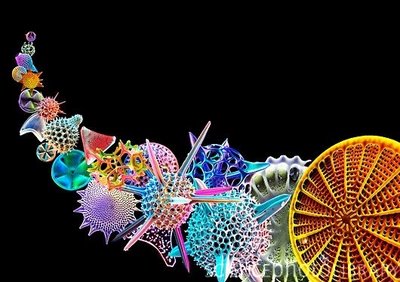
Images: diatom art (ref 2)
Now for the applied part. Humans would really like to capture the inherent ability of diatoms to create this repeatable nanostructure to create highly useful products like semiconductors (ref 3). Current industrial processes are hugely energy intensive, and yet diatoms do it all of the time using proteins. There is also much interest in using diatom frustules for drug delivery (ref 4) and even as an energy harvesting element in solar cells (reviewed in ref 5). The tiny diatom pores in the biological solar cells greatly increases efficiency compared to traditional solar cells.

Image: layout of a diatom-titanium dioxide thin film solar cell (ref 6)
Those are just two HUGE ways that diatoms affect the lives of everyday people. I may not have made that clear enough in my 750-word application, but I hope that I have convinced anyone who reads this that diatoms are worth of our attention.
References
1. Diatomite image: http://www.elkorose.com/vivian.html
2. Diatom art: bensonapbiology.concordcarlisle.wikispaces.ne; pedrofoglia.com.ar
3. Gordon et al. The glass menagerie: diatoms for novel applications in nanotechnology. Trends in Biotechnology 27(2): 116-127.
4. De Stefano et al. Inerfacing the nanostructured biosilica microshells of the marine diatom Coscinodiscus wailesii with biological matter. Acta Biomaterialia 4(1): 126-130.
5. Chapter 35 in: The diatoms: applications for the environmental and earth sciences (vol II). 2010. J. Smol, editor. Cambridge University Press. 686 pages.
6. Greg Rorrer lab, Oregon State University. http://oregonstate.edu/engr/rorrer/
Sunday, April 10, 2011
Yeast
Yeast
The leader in libations, the king of the kitchen, this tiny organism rises to the top when it comes to making delicious food. Of course, I'm talking about the fomenter of fermentation, Saccharomyces cerevisiae, more commonly known as yeast.

Scanning electron microscope images of yeast cells (source: Chemistryland.com). Yeast cells divide by a process called budding, present on these cells as small round dots.
Under low oxygen conditions, Saccharomyces, or "sugar fungus", can perform a very special form of metabolism called ethanol fermentation. The production of CO2 gas causes bread to rise and gives beer and champagne its fizz. And the ethanol? Well, you know. But, of course, the yeast really care about the energy produced by fermentation that sustains growth and reproduction. I'll note here that yeast grows a lot more efficiently using aerobic respiratory metabolism (like us humans) than anaerobic fermentation.


Making beer is fun! At the Microbial Diversity course in Woods Hole, MA, students learn first-hand about yeast fermentation.
Yeast in the Environment
In the family tree of life, S. cerevisiae belongs to the domain Eukarya (meaning it's more closely related to humans than to bacteria), and the phylum Fungi. While we generally refer to S. cerevisiae as 'yeast', there are many species that belong to this broader yeast group. Some species have real benefits to us (like baker's yeast), while we don't know very much about many (like most organisms...), and others cause illness (e.g. Candida species). In the environment, fungi play an important role in cycling nutrients by decomposing organic matter so that nutrients become available for plants and micro-organisms. They are the "filters" of the environment, so it's no surprise that they do a great job cleaning up polluted land. S. cerevisiae and other yeasts are known to remediate Chromium (1), a poisonous metal that was made famous in the Julia Roberts film "Erin Brockovich".
Yeast is a relatively simple eukaryotic organism, being single-celled and easy to grow in a laboratory setting. For these reasons, it has become a model organism for scientific research. We have learned a lot about ourselves through understanding the biology of yeast cells. Some truly revolutionary analytical tools were developed using yeast, such as the two-hybrid assay (2), which has revealed insights into cancer biology (3), endocrine disruptors (4), and cell signaling (5), among much more.
We all can appreciate a tiny organism that can make delicious tasting food and beverages. But now that we know that there is so much more to this important microbe, we should all bow down to the king of the kitchen.
References
1. Ksheminska et al., Process Biochemistry, 2005: 1565-1572.
2. Interested? Check out Wikipedia for more information!
3. Li and Fields, FASEB Journal, 1993: 957-963.
4. Nishihara et al., Journal of Health Science, 2000: 282-298.
5. Staudinger et al., Journal of Cell Biology, 1995: 263-271.
The leader in libations, the king of the kitchen, this tiny organism rises to the top when it comes to making delicious food. Of course, I'm talking about the fomenter of fermentation, Saccharomyces cerevisiae, more commonly known as yeast.

Scanning electron microscope images of yeast cells (source: Chemistryland.com). Yeast cells divide by a process called budding, present on these cells as small round dots.
Under low oxygen conditions, Saccharomyces, or "sugar fungus", can perform a very special form of metabolism called ethanol fermentation.
 The production of CO2 gas causes bread to rise and gives beer and champagne its fizz. And the ethanol? Well, you know. But, of course, the yeast really care about the energy produced by fermentation that sustains growth and reproduction. I'll note here that yeast grows a lot more efficiently using aerobic respiratory metabolism (like us humans) than anaerobic fermentation.

Making beer is fun! At the Microbial Diversity course in Woods Hole, MA, students learn first-hand about yeast fermentation.
Yeast in the Environment
In the family tree of life, S. cerevisiae belongs to the domain Eukarya (meaning it's more closely related to humans than to bacteria), and the phylum Fungi. While we generally refer to S. cerevisiae as 'yeast', there are many species that belong to this broader yeast group. Some species have real benefits to us (like baker's yeast), while we don't know very much about many (like most organisms...), and others cause illness (e.g. Candida species). In the environment, fungi play an important role in cycling nutrients by decomposing organic matter so that nutrients become available for plants and micro-organisms. They are the "filters" of the environment, so it's no surprise that they do a great job cleaning up polluted land. S. cerevisiae and other yeasts are known to remediate Chromium (1), a poisonous metal that was made famous in the Julia Roberts film "Erin Brockovich".
Yeast is a relatively simple eukaryotic organism, being single-celled and easy to grow in a laboratory setting. For these reasons, it has become a model organism for scientific research. We have learned a lot about ourselves through understanding the biology of yeast cells. Some truly revolutionary analytical tools were developed using yeast, such as the two-hybrid assay (2), which has revealed insights into cancer biology (3), endocrine disruptors (4), and cell signaling (5), among much more.
We all can appreciate a tiny organism that can make delicious tasting food and beverages. But now that we know that there is so much more to this important microbe, we should all bow down to the king of the kitchen.
References
1. Ksheminska et al., Process Biochemistry, 2005: 1565-1572.
2. Interested? Check out Wikipedia for more information!
3. Li and Fields, FASEB Journal, 1993: 957-963.
4. Nishihara et al., Journal of Health Science, 2000: 282-298.
5. Staudinger et al., Journal of Cell Biology, 1995: 263-271.
Subscribe to:
Posts (Atom)